
Overview
[About Chemical Substance Risk Assessment]
Businesses that manufacture or handle specific chemical substances are required to conduct chemical substance risk assessments regardless of their industry.
[Overview of the Chemical Substance Risk Assessment Process]
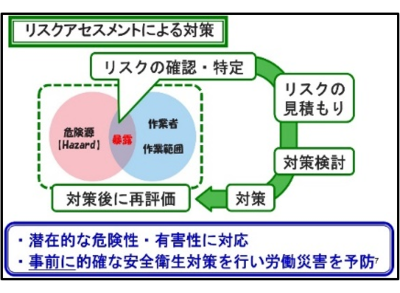
① Identify the hazards and harmful properties of chemical substances and their preparations
② Estimate the risks of danger and health impairment to workers based on the identification results
③ Consider risk reduction measures based on the assessment results
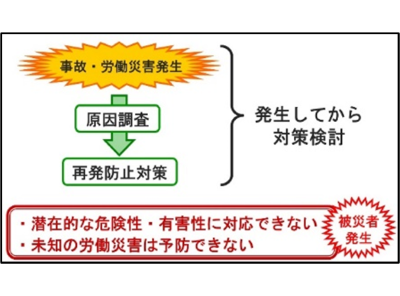
Proper risk assessment enables the prevention of harm to workers before it occurs, while protecting workers' health, considering risk control measures, and prioritizing necessary actions.
We provide consultations regarding the introduction of chemical substance risk assessment methods, assistance in selecting appropriate methods, and risk assessments based on actual measured values obtained from various environmental measurements.
Applications
Situations Where Risk Assessment Is Required
① When adopting a new substance or changing substances previously handled
② When newly adopting or changing work methods or procedures for handling substances
③ When new information regarding hazards or harmful properties is obtained
Situations Where Efforts Are Required Under Guidelines
① When a workplace accident involving chemical substances occurs and there are issues with previously conducted risk assessments or related measures
② When the risk situation is considered to have changed (such as deterioration of equipment over time or changes in workers' knowledge and experience)
③ When risk assessments have never been conducted in the past
In addition to these situations, risk assessments can also be conducted as part of considering countermeasures when environmental measurement results are unfavorable (for example, when workplace environmental measurements indicate that "there is room for improvement in the work environment / the conditions are not satisfactory").
Introduction of Risk Assessment Methods
Below are some examples of methods used for conducting chemical substance risk assessments.
Evaluation Method Using Actual Measurement Values
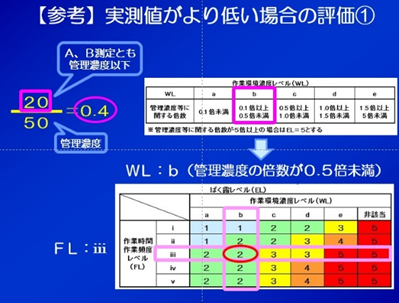
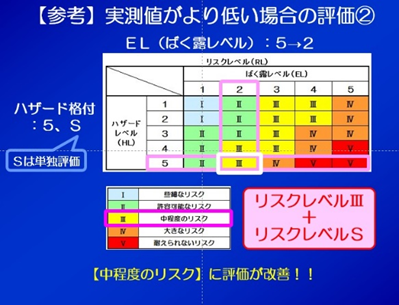
This method identifies and classifies hazards and other properties using the SDS (Safety Data Sheet) of the target substance, then determines the risk level by incorporating actual measurement values obtained through workplace environmental measurements and other methods.


Reference: Published by Japan Industrial Safety and Health Association
"How to Proceed with Chemical Substance Risk Assessment to Prevent Health Impairment"
Method Using Control Banding
This is a simplified risk assessment method focusing on the hazards of chemical substances, using information on the [hazard category of handled substances] and [exposure level]. Support tools are provided by organizations such as the Ministry of Health, Labour and Welfare.
Reference: Ministry of Health, Labour and Welfare - Safety Site for Workplaces
[Support for Implementing Chemical Substance Risk Assessment]
https://anzeninfo.mhlw.go.jp/user/anzen/kag/ankgc07.htm#h2_2
[MHLW Control Banding]
https://anzeninfo.mhlw.go.jp/user/anzen/kag/ankgc07_1.htm
Reference: Safety Site for Workplaces
[Support for Implementing Chemical Substance Risk Assessment]
https://anzeninfo.mhlw.go.jp/user/anzen/kag/ankgc07.htm#h2_2
[MHLW Control Banding]
https://anzeninfo.mhlw.go.jp/user/anzen/kag/ankgc07_1.htm
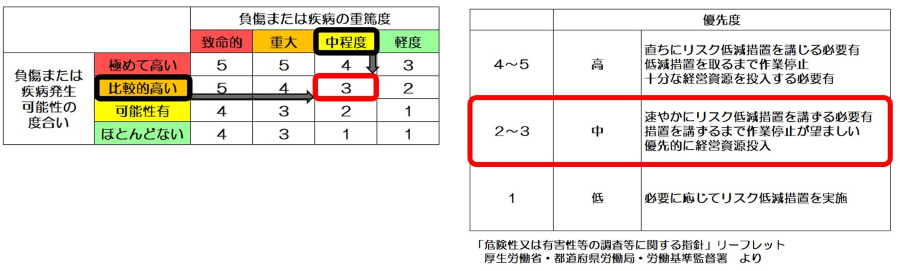
Matrix-Based Method
A method that calculates risk as:
(Likelihood of injury or illness occurring) × (Severity of impact) = (Risk)
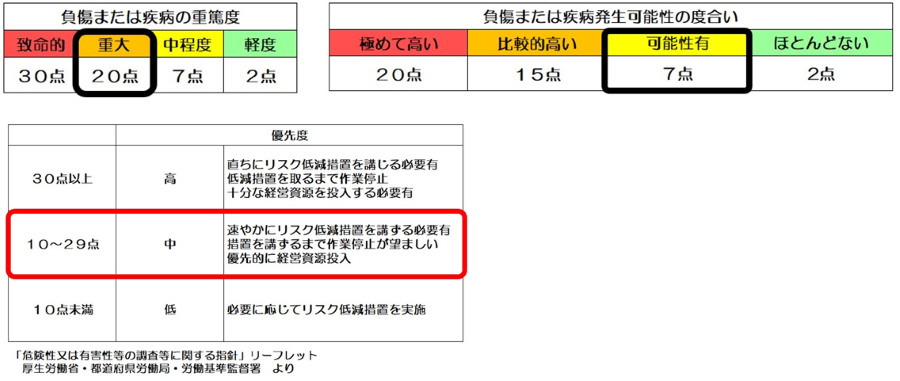
Numerical Scoring Method
A method that calculates risk as:
(Likelihood score of injury or illness occurring) + (Severity score) = (Risk score)
>
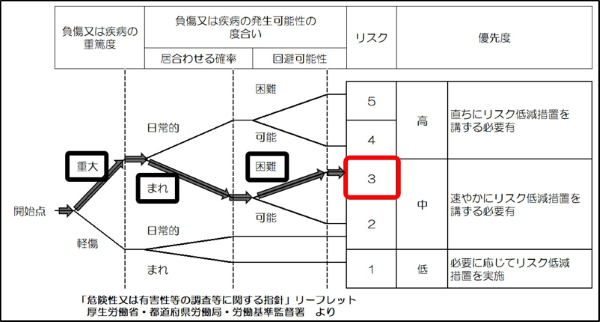
Method Using a Decision Tree
A method for estimating risk based on combinations of (risk parameters) and (risk levels / severity, frequency, ease of avoidance, etc.).
Features
We provide comprehensive support from chemical substance concentration measurements to risk assessment assistance. By utilizing actual measurement results, risk estimation and evaluation can be based on actual workplace conditions, enabling more practical consideration and prioritization of risk reduction measures.
Methods that estimate risks based only on the general properties of chemical substances may sometimes result in excessive safety measures or unrealistic responses being considered necessary. By conducting risk assessments using workplace environmental measurement results and personal exposure measurement results, risks can be accurately estimated, providing a basis for considering more practical countermeasures.
We also provide consultation regarding follow-up after implementing risk assessments.
We can also assist with introductions to local exhaust ventilation equipment manufacturers and support for considering countermeasures with occupational health consultants.
Case Studies and Achievements
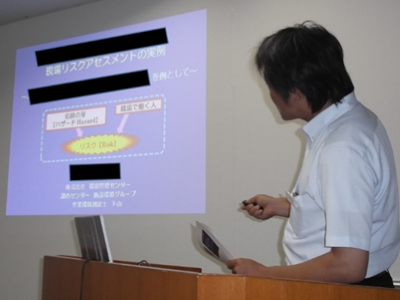
We have conducted risk assessments using actual measurement values obtained through workplace environmental measurements performed by our company, and have provided explanatory sessions incorporating actual calculation examples within customers' organizations.
Notes
We also provide support for inquiries such as: "I would like to know more about chemical substance risk assessments," "I would like to confirm whether a chemical substance risk assessment is required," "I would like to learn how to conduct a risk assessment," or "I would like you to conduct an actual risk assessment demonstration."
