
Research
We conduct a wide range of research to address diverse environmental issues, including the development of analytical methods for trace hazardous substances, risk assessment, and environmental remediation technologies. We also carry out research in the agricultural field, such as methods for controlling parasitic organisms that affect crops.
Development of a Rapid Method for Measuring Airborne Fiber Concentrations Using AI-Assisted SEM
In May 2022, Mr. Iida, General Manager of our Engineering Department, received the Young Researcher Paper Award from the Academic Committee of the Japan Society for Occupational Health.
In Japan, the manufacture and use of asbestos, a known carcinogen, have been completely prohibited since September 2006.
However, approximately 8 million tons of asbestos-containing building materials still remain in existing buildings.
During the demolition or renovation of buildings containing asbestos, the release of asbestos fibers into the surrounding environment has become a significant social concern, making the prevention of emissions from construction sites an urgent issue.
One of the primary management measures is the measurement of airborne asbestos concentrations, which requires both rapid and highly accurate analysis.
Currently, the most widely used method in Japan employs phase-contrast microscopy (PCM), in which trained technicians visually count fibers. This process is both labor-intensive and time-consuming.
In this study, we investigated a new measurement method that combines scanning electron microscopy (SEM) with artificial intelligence (AI), enabling faster analysis, the detection of finer fibers, and more accurate fiber counting than conventional methods.
For further details, please refer to the following publication:
https://doi.org/10.1002/1348-9585.12238
Development of a Metagenomic Diagnostic Method for Soybean Cyst Nematodes and
Control Technology Using Unutilized Biomass
Soil-borne pests and pathogens, such as fungi, bacteria, and nematodes, cause significant damage to agricultural crops. Although pesticides are commonly used to control these organisms, some contain tear-inducing chemicals or substances suspected of being carcinogenic. Therefore, minimizing pesticide use is important for protecting both human health and the environment.
Our company is developing a diagnostic method based on metagenomic analysis that enables the rapid quantitative detection of soybean cyst nematodes, which have recently become a serious problem for edamame production in suburban farming areas. We are also developing an environmentally friendly control technology that utilizes discarded bean sprout residue generated by fresh-cut vegetable and bean sprout processing facilities.
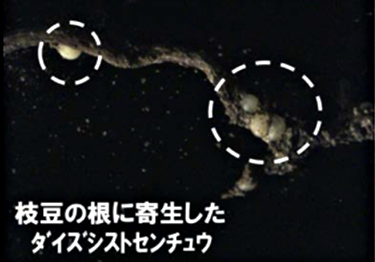
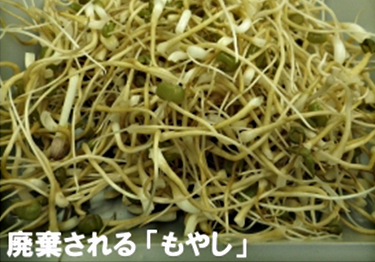
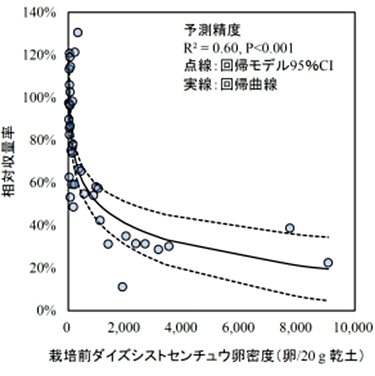
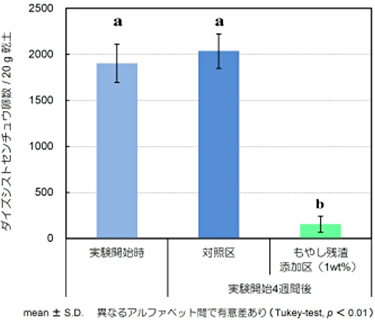
Figure: Relationship between soybean cyst nematode density before cultivation (quantified using the metagenomic method) and edamame yield (left),
and the effectiveness of bean sprout residue in reducing soybean cyst nematode density (right).
Related Publications
- 1. Toyoda et al.: Effects of Bean Sprout Residue on the Hatching and Population Density of Soybean Cyst Nematodes in Soil (English), Nematology, Vol. 15, pp. 923–929 (2013)
- 2. Ito et al.: Control of Soybean Cyst Nematodes Using Water Extracts of Bean Sprout Residue (English), Nematology, Vol. 17, pp. 523–530 (2015)
- 3. Ito et al.: Effects of Cultivation Factors, Soil Chemical Properties, and Soybean Cyst Nematodes on Edamame Yield under Greenhouse Cultivation, Nematology, Vol. 19, pp. 237–244 (2017)
Elucidation of the Health Risks of Airborne Nanoparticles
Among airborne particulate matter, nanoparticles (ultrafine particles) with diameters of 0.1 μm or less have been shown to exhibit high toxicity, including strong mutagenic activity and the ability to induce oxidative stress, in addition to their high deposition efficiency in the alveoli of the lungs.
As the next stage of our research, we are investigating the chemical compounds responsible for the toxicity of nanoparticles. Our studies have demonstrated that nitro-polycyclic aromatic hydrocarbons (Nitro-PAHs), particularly 1,8-dinitropyrene, are major contributors to the high mutagenic activity exhibited by airborne nanoparticles.
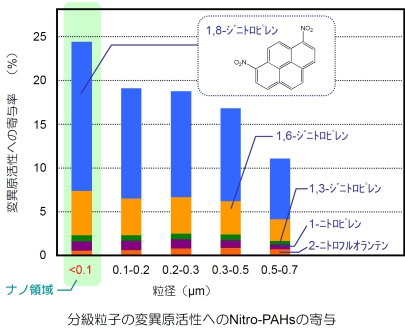
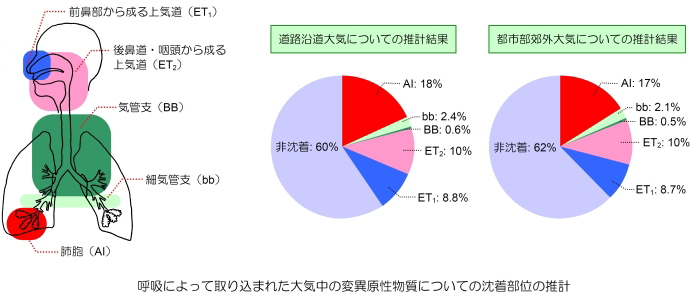
Furthermore, using the Lung Dose Evaluation Program (LUDEP), we found that approximately 20% of airborne mutagenic substances are deposited in the alveolar region (AI region in the figure below). Our analysis also revealed that nanoparticles play a significant role in the deposition of these mutagenic substances in the lungs.
Related Publications
- 1. Kawanaka et al.: Mutagenicity of Size-Fractionated Airborne Particles Collected Using a Low-Pressure Impactor (English), Atmospheric Environment, Vol. 38, pp. 2125–2132 (2004)
- 2. Kawanaka et al.: Contribution of Nitro-Polycyclic Aromatic Hydrocarbons to the High Mutagenic Activity of Ultrafine Particles (English), Atmospheric Environment, Vol. 42, pp. 7423–7428 (2008)
- 3. Kawanaka et al.: Estimation of the Contribution of Ultrafine Particles to the Respiratory Deposition of Polycyclic Aromatic Hydrocarbons (English), Environmental Science & Technology, Vol. 43, pp. 6851–6856 (2009)
- 4. Kawanaka et al.: Estimation of the Contribution of Ultrafine Particles (Nanoparticles) to the Pulmonary Deposition of Airborne Particulate Mutagens (English), Science of the Total Environment, Vol. 409, pp. 1033–1038 (2011)
Development of Highly Sensitive Analytical Methods for Newly Emerging Contaminants of Concern
A vast number of chemical substances exist in the environment. While some are monitored or regulated, many have not yet been adequately assessed for their risks, and even their environmental concentrations remain largely unknown.
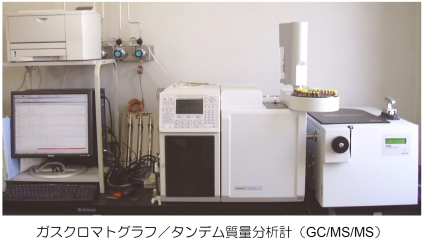
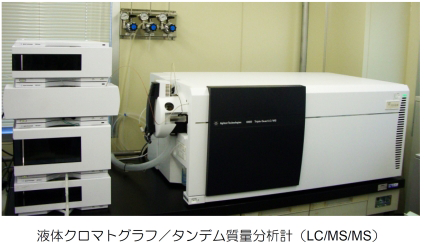
Our company identifies chemicals and chemical groups that require particular attention based on their toxicity and bioaccumulation potential. We develop highly sensitive analytical methods using state-of-the-art instruments, including gas chromatography–tandem mass spectrometry (GC/MS/MS) and liquid chromatography–tandem mass spectrometry (LC/MS/MS), and apply these methods to environmental monitoring.
We also contribute to society through our analytical expertise by participating as committee members in the development of Japanese Industrial Standards (JIS) for the analysis of PFOS and PFOA.
Examples of Analytical Method Development
- Analytical methods for perfluorinated compounds (PFOS, PFOA, etc.) and estrogens using LC/MS/MS
- Analytical methods for organoarsenic compounds (including chemical warfare agents and pesticide-related substances) using LC-ICP/MS
Related Publications
- 1. Ishii et al.: Determination of Estrogens in Environmental Water by Liquid Chromatography–Tandem Mass Spectrometry, Bunseki Kagaku (Analytical Chemistry), Vol. 49, pp. 753–757 (2000)
- 2. Imai et al.: Determination of Diphenylarsinic Acid and Phenylarsonic Acid in Water Samples by High-Performance Liquid Chromatography–Inductively Coupled Plasma Mass Spectrometry, Bunseki Kagaku (Analytical Chemistry), Vol. 54, pp. 631–636 (2005)
- 3. Kawanaka et al.: Highly Sensitive Analysis of Nitro-Polycyclic Aromatic Hydrocarbons in Diesel Exhaust Particles Using Gas Chromatography/Negative Chemical Ionization Tandem Mass Spectrometry (English), Journal of Chromatography A, Vol. 1163, pp. 312–317 (2007)
Development of Bioremediation Technology for POPs Pesticides Using Microorganisms
Persistent Organic Pollutants (POPs) are highly toxic and resistant to degradation, making their removal an important international environmental priority. Bioremediation using microorganisms is regarded as a promising technology for the remediation of soils contaminated with low concentrations of POPs over wide areas.
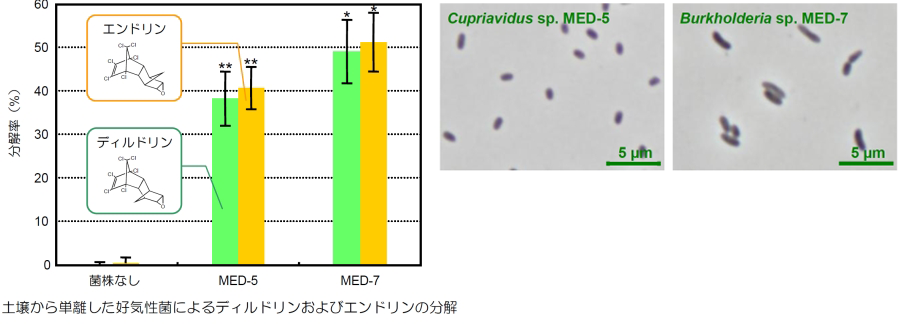
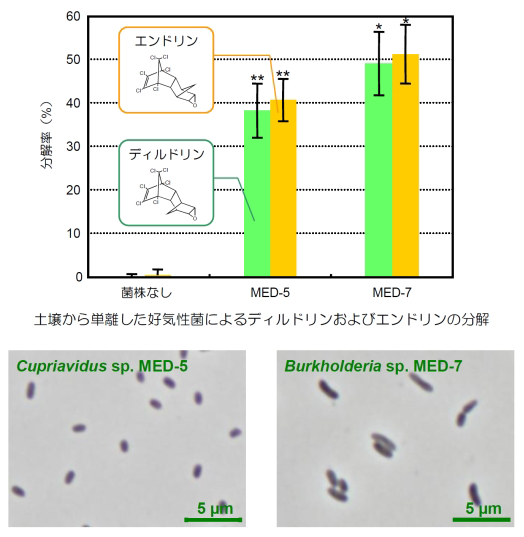
Our research focuses on dieldrin and endrin, two organochlorine pesticides classified as POPs. We have identified culture conditions that selectively promote the growth of microorganisms capable of degrading these compounds and have successfully isolated several novel degrading strains (MED-5 and MED-7). A patent application for this technology is currently pending.
This patent application represents the first in Japan concerning microorganisms capable of degrading drin pesticides. We are currently evaluating the practical applicability of this technology for the remediation of POPs-contaminated sites.
Related Publications
- 1. Matsumoto et al.: Environmental Persistence and Microbial Degradation of the Organochlorine Pesticides Dieldrin and Endrin (English), Applied Microbiology and Biotechnology, Vol. 84, pp. 205–216 (2009)
- 2. Matsumoto et al.: Isolation of Dieldrin- and Endrin-Degrading Microorganisms Using the Analog Compound 1,2-Epoxycyclohexane (English), Applied Microbiology and Biotechnology, Vol. 80, pp. 1095–1103 (2008)
Research Publications
*Click on Academic Papers, Conference Presentations, or Publications to view details.
Academic Papers
Academic papers published by our researchers.
Effects of Cultivation Factors, Soil Chemical Properties, and Soybean Cyst Nematodes on Yield in Greenhouse-Grown Edamame
(English, Co-authored)
Nematology 19, 237–244 (2017)
Daisuke Ito, Takemi Toyoda1, Zhen Guang Li1
1Tokyo University of Agriculture and Technology
Control of Soybean Cyst Nematodes Using Water Extracts of Bean Sprout Residues
(English, Co-authored)
Nematology 17, 523–530 (2015)
Daisuke Ito, Takemi Toyoda1, Ghalia Missous Sedrati1
1Tokyo University of Agriculture and Technology
Simultaneous Determination of 30 Elements Including Silicon in PM2.5 by Acid Digestion/ICP-MS
Journal of Japan Society for Atmospheric Environment, 50, 192–198 (2015)
Hiroko Tsujimoto, Junko Yamaoka, Fumihiro Nakachi, Yohei Kawanaka
Method for Measuring Airborne Asbestos Concentration
Living and Environment, April 2014 Issue, 31–35 (2014)
Toshiyuki Toyoguchi
Effects of Bean Sprout Residues on the Hatching and Population Density of Soybean Cyst Nematodes in Soil
(English, Co-authored)
Nematology 15, 923–929 (2013)
Takemi Toyoda1, Keita Goto1, Daisuke Ito
1Tokyo University of Agriculture and Technology
Quality Control of Radioactivity Analysis in Waste Treatment
Journal of the Japan Society of Material Cycles and Waste Management, 24, 281–290 (2013)
Yukihiro Yoshida
This paper describes quality control procedures for radioactivity analysis in the treatment of waste contaminated with radioactive materials released from the Fukushima Daiichi Nuclear Power Plant accident. It also provides practical examples of quality control methods and briefly discusses the measurement of surface contamination density and ambient dose rates using survey meters.
Investigation into the Degree of Deterioration of Asbestos-Containing Building Materials and the Potential for Airborne Dispersion of Asbestos Fibers in Indoor Environments
(Co-authored)
Journal of Structural and Construction Engineering (AIJ), 78, 1055–1059 (2013)
Junko Koga1, Masato Kawaguchi2, Ken Wakui3, Yoshinaga Oyama4, Tamotsu Komatsu5, Toshiyuki Toyoguchi, Kenji Motohashi6, Motoyasu Kamata7
1Building Research Institute
2Shimizu Corporation Institute of Technology
3Kajima Corporation, Building Engineering Division
4Taisei Corporation Technology Center
5Takenaka Corporation, Tokyo Main Office (formerly Safety & Environmental Department)
6Shibaura Institute of Technology / Building Research Institute
7The University of Tokyo
Investigation into the Degree of Deterioration of Asbestos-Containing Chimney Insulation and the Potential for Indoor Dispersion of Asbestos Fibers
(Co-authored)
Journal of Structural and Construction Engineering (AIJ), 78, 665–670 (2013)
Junko Koga1, Masato Kawaguchi2, Ken Wakui3, Yoshinaga Oyama4, Tamotsu Komatsu5, Toshiyuki Toyoguchi, Kenji Motohashi6, Motoyasu Kamata7
1Building Research Institute
2Shimizu Corporation Institute of Technology
3Kajima Corporation, Building Engineering Division
4Taisei Corporation Technology Center
5Takenaka Corporation, Tokyo Main Office (formerly Safety & Environmental Department)
6Shibaura Institute of Technology / Building Research Institute
7The University of Tokyo
Concentrations and Composition Profiles of Perfluorinated Compounds in Tap Water in Tokyo
Journal of Japan Society on Water Environment 35, 57–64 (2012)
Shiho Imai, Yohei Kawanaka, Yoshiteru Tsuchiya, Sunja Yoon
Perfluorinated compounds (PFCs), including perfluorooctane sulfonate (PFOS) and perfluorooctanoic acid (PFOA), have raised concerns because of their persistence in the environment and potential accumulation in the human body. This study measured PFC concentrations in tap water in Tokyo and evaluated the importance of drinking water as a pathway of human exposure.
Estimation of the Contribution of Ultrafine (Nano) Particles to the Pulmonary Deposition of Particulate Mutagenic Substances in the Atmosphere
(English, Co-authored)
Science of the Total Environment 409, 1033–1038 (2011)
Yohei Kawanaka, Emiko Matsumoto, Kazuhiko Sakamoto, Sunja Yoon
Atmospheric particulate matter contains various mutagenic substances that enter the human body through respiration. This paper estimated, using a respiratory deposition model, the regions of the respiratory tract where these mutagenic substances are deposited and evaluated the extent to which nanoparticles contribute to their deposition in the alveolar region.
Evaluation of the Long-Term Stability of Heavy Metals in Chelate-Treated Molten Fly Ash Collected from a Final Disposal Site
Journal of the Japan Society of Material Cycles and Waste Management 21, 86–93 (2010)
Hiroko Tsujimoto, Ning Wang, Hirofumi Sakakura, Masahiro Osako
Chemical treatment using liquid chelating agents is commonly employed to suppress the leaching of heavy metals from molten fly ash. However, concerns remain regarding the long-term stability of metal-chelate compounds in treated fly ash. This paper reports the results of an investigation into the presence of metal-chelate compounds and the leaching characteristics of heavy metals in fly ash samples collected from a landfill dedicated to molten fly ash.
Environmental Fate and Microbial Degradation of the Organochlorine Pesticides Dieldrin and Endrin
(English)
Applied Microbiology and Biotechnology 84, 205–216 (2009)
Emiko Matsumoto, Yohei Kawanaka, Sunja Yoon, Hiroshi Oyaizu
Although the use of the organochlorine pesticides dieldrin and endrin was banned nearly 40 years ago, they are still detected in crops, soils, and other environmental media. This review summarizes their environmental persistence and discusses the potential of microorganisms and plants for use in bioremediation and phytoremediation as promising approaches for their removal.
Estimation of the Contribution of Ultrafine Particles to the Respiratory Deposition of Polycyclic Aromatic Hydrocarbons
(English)
Environmental Science and Technology 43, 6851–6856 (2009)
Yohei Kawanaka, Yoshiteru Tsuchiya, Sunja Yoon, Kazuhiko Sakamoto
Ultrafine particles, with diameters of less than 100 nm, are known to penetrate deeply into the respiratory system. This paper demonstrates that ultrafine particles play an important role as carriers of polycyclic aromatic hydrocarbons (PAHs), one of the major carcinogenic and mutagenic substances in the atmosphere, to the alveolar region of the lungs.
Legal Regulations Based on the Concept of Ecosystem Conservation and Public Response
Japanese Journal of Environmental Sociology 15, 132–138 (2009)
Sakiko Ninomiya
Environmental policies based on ecosystem conservation are relatively new, and few studies have examined their implementation and associated challenges. Using the Kushiro Wetland watershed in Hokkaido as a case study, this research employed qualitative social research methods—including interviews with local residents, participant observation, and document analysis—to demonstrate the importance of environmental policies that take regional characteristics and the impacts of invasive species on both ecosystems and local communities into account.
Isolation of Dieldrin- and Endrin-Degrading Bacteria Using the Analog Compound 1,2-Epoxycyclohexane
(English)
Applied Microbiology and Biotechnology 80, 1095–1103 (2008)
Emiko Matsumoto, Yohei Kawanaka, Sunja Yoon, Hiroshi Oyaizu
Although bioremediation using microorganisms is considered a promising approach for remediating soils contaminated with the organochlorine pesticides dieldrin and endrin, highly effective degrading microorganisms had not previously been identified. This paper describes the development of an efficient and selective cultivation method for isolating dieldrin-degrading bacteria and reports the successful isolation of two aerobic bacterial strains with exceptionally high degradation activity.
Contribution of Nitro-Polycyclic Aromatic Hydrocarbons to the High Mutagenic Activity of Ultrafine Particles
(English)
Atmospheric Environment 42, 7423–7428 (2008)
Yohei Kawanaka, Emiko Matsumoto, Ning Wang, Sunja Yoon, Kazuhiko Sakamoto
Ultrafine particles in the atmosphere have become a public health concern because they can penetrate deep into the respiratory tract. This paper demonstrates that ultrafine particles exhibit exceptionally high mutagenic activity (mutagenicity per unit mass) and identifies nitro-polycyclic aromatic hydrocarbons (Nitro-PAHs) as major contributors to this high mutagenic activity.
Highly Sensitive Determination of Nitro-Polycyclic Aromatic Hydrocarbons in Diesel Exhaust Particles by Gas Chromatography/Negative-Ion Chemical Ionization Tandem Mass Spectrometry
(English)
Journal of Chromatography A 1163, 312–317 (2007)
Yohei Kawanaka, Kazuhiko Sakamoto, Ning Wang, Sunja Yoon
Nitro-polycyclic aromatic hydrocarbons are recognized as highly potent mutagenic compounds found in the atmosphere and diesel exhaust particles. However, their determination has been challenging because of their extremely low concentrations. This paper reports a simple and highly sensitive analytical method for these compounds using gas chromatography/negative-ion chemical ionization tandem mass spectrometry.
Comparison of the Mutagenic Activity of Ultrafine Particles in Roadside and Urban Suburban Atmospheres
(English)
Journal of Health Science 52, 352–357 (2006)
Yohei Kawanaka, Emiko Matsumoto, Ning Wang, Yoshiteru Tsuchiya, Z. U. Jiang, Sunja Yoon
Roadside environments generally have higher concentrations of airborne particulate matter, raising concerns about respiratory health risks. This study compared the toxicity of size-fractionated airborne particulate matter collected from roadside and urban suburban areas.
Determination of Diphenylarsinic Acid and Phenylarsonic Acid in Water Samples by High-Performance Liquid Chromatography/Inductively Coupled Plasma Mass Spectrometry
Bunseki Kagaku (Analytical Chemistry) 54, 631–636 (2005)
Shiho Imai, Yohei Kawanaka, Ning Wang, Sunja Yoon
Because the toxicity of arsenic compounds varies greatly depending on their chemical species, speciation analysis is essential for accurate risk assessment. This paper describes the development of a method for the simultaneous separation and determination of seven arsenic compounds, including diphenylarsinic acid and phenylarsonic acid, which are associated with chemical weapons and pesticides.
Investigation of the Genetic Diversity of Hydropsyche orientalis by PCR-SSCP Analysis
Bulletin of the Biogeographical Society of Japan 60, 42–46 (2005)
Yoshio Hayashi
Determination of Nitroarenes and 3-Nitrobenzanthrone in Airborne Particulate Matter by Gas Chromatography/Negative-Ion Chemical Ionization Tandem Mass Spectrometry
Bunseki Kagaku (Analytical Chemistry) 54, 685–692 (2005)
Yohei Kawanaka, Kazuhiko Sakamoto, Ning Wang, Sunja Yoon
Mutagenicity of Size-Fractionated Airborne Particulate Matter Collected Using a Low-Pressure Impactor
(English)
Atmospheric Environment 38, 2125–2132 (2004)
Yohei Kawanaka, Emiko Matsumoto, Kazuhiko Sakamoto, Ning Wang, Sunja Yoon
Analysis of Pharmaceuticals in Environmental Water by Liquid Chromatography/Tandem Mass Spectrometry
Journal of Environmental Chemistry 14, 127–134 (2004)
Yoshiaki Ishii, Ning Wang, Sunja Yoon
Particle Size Distribution and Seasonal Variation of 1-Nitropyrene and Polycyclic Aromatic Hydrocarbons in Ambient Airborne Particles
Environmental Chemistry 12, 599–607 (2002)
Yohei Kawanaka, Ning Wang, Soonja Yoon, Kazuhiko Sakamoto
A Biogeographical Study of Cheumatopsyche infascia (Trichoptera, Hydropsychinae) Using Esterase Isozymes
Biogeography 4, 1–4 (2002)
Yoshio Hayashi, Soonja Yoon
Bioremediation Technologies for Environmental Restoration
Environmental Chemistry 12, 67–72 (2002)
Emiko Matsumoto
Analytical Method for Carbendazim and Thiabendazole in River Sediments Using Liquid Chromatography/Tandem Mass Spectrometry
Environmental Chemistry 12, 141–145 (2002)
Satoru Okita, Yoshiaki Ishii, Soonja Yoon
Determination of Nitropyrenes and Dinitropyrenes in Airborne Particulate Matter by Liquid Chromatography/Tandem Mass Spectrometry
Environmental Chemistry 11, 267–272 (2001)
Yohei Kawanaka, Soonja Yoon
Distribution of Cheumatopsyche (Hydropsychidae) Larvae and Environmental Factors in the Tama River System
Japanese Journal of Limnology 62, 51–59 (2001)
Yoshio Hayashi, Kazutoshi Machida, Soonja Yoon
Determination of Carbendazim and Thiabendazole in Environmental Water by Solid-Phase Extraction/Liquid Chromatography/Tandem Mass Spectrometry
Analytical Chemistry 50, 127–132 (2001)
Satoru Okita, Yoshiaki Ishii, Soonja Yoon
Determination of Nonylphenol Polyethoxylates in River Water and Wastewater Treatment Plant Effluent by LC/MS/MS
Environmental Chemistry 10, 607–614 (2000)
Yohei Kawanaka, Makoto Torigai, Soonja Yoon
Analysis of Estrogens in Wastewater Treatment Plant Effluent and River Water by GC/MS
Environmental Chemistry 10, 595–600 (2000)
Makoto Torigai, Yoshiaki Ishii, Soonja Yoon, Tsuneo Hashiba
Determination of Estrogens in Environmental Water by Liquid Chromatography/Tandem Mass Spectrometry
Analytical Chemistry 49, 753–757 (2000)
Yoshiaki Ishii, Satoru Okita, Makoto Torigai, Soonja Yoon
Migration of Nonylphenol and Bisphenol A from Food Packaging Wrap Films
Environmental Chemistry 10, 73–78 (2000)
Yohei Kawanaka, Makoto Torigai, Soonja Yoon, Tsuneo Hashiba, Kiyoshi Iwashima
Association Between Larval and Adult Stages of Cheumatopsyche galloisi (Matsumura, 1931) (Trichoptera: Hydropsychidae) Using Esterase Analysis
Japanese Journal of Limnology 60, 379–384 (1999)
Yoshio Hayashi, Soonja Yoon
Evaluation of Internal Standards for the Determination of β-Estradiol in Environmental Samples
Analytical Chemistry 48, 725–729 (1999)
Makoto Torigai, Satoru Okita, Soonja Yoon, Tsuneo Hashiba, Kiyoshi Iwashima
Rapid Simultaneous Determination of Trace Metals in Environmental Water by ICP-AES Following Collection and Preconcentration on an Iminodiacetate Chelating (IED) Membrane
Analytical Chemistry 48, 725–729 (1999)
Makoto Torigai, Satoru Okita, Soonja Yoon, Tsuneo Hashiba, Kiyoshi Iwashima
Leaching Potential of Hazardous Metals in Waste Materials: Evaluation of Leaching Test Results Using a Sequential Extraction Method
Journal of the Japan Society of Waste Management Experts 10, 142–151 (1999)
Tong Ouyang, Makoto Torigai, Ruriko Sakai, Ning Wang, Soonja Yoon, Kiyoshi Iwashima, Masahiro Osako
Classification of Three Japanese Cheumatopsyche Species (Trichoptera: Hydropsychidae) Based on Enzyme Polymorphism
Japanese Journal of Limnology 59, 175–183 (1998)
Yoshio Hayashi
Concentrations, Chemical Speciation, and Sources of Chromium, Molybdenum, and Antimony in the Tama River
Environmental Chemistry 8, 33–45 (1998)
Tong Ouyang, Makoto Torigai, Satoru Okita, Kazuhiko Baba, Soonja Yoon, Kiyoshi Iwashima
Determination of Selenium in Municipal Solid Waste Incinerator Fly Ash by Microwave Digestion and Graphite Furnace Atomic Absorption Spectrometry with Zeeman Background Correction
Analytical Chemistry 47, 195–198 (1998)
Makoto Torigai, Tong Ouyang, Kiyoshi Iwashima, Masahiro Osako, Masaru Tanaka
Screening of Dioxins by Enzyme Immunoassay
Journal of the Japan Society of Waste Management Experts 8, 311–320 (1997)
Ruriko Sakai, Masahiro Osako, Yukihiro Yoshida, Naoki Haga, Kiyoshi Iwashima, Masaru Tanaka
Simultaneous Determination of Inorganic As(III), Sb(III), and Se(IV) by HG/ICP-AES Using a Citrate Buffer
Environmental Chemistry 7, 267–273 (1997)
Ning Wang, Tong Ouyang, Soonja Yoon, Kiyoshi Iwashima
Microwave Digestion Method for the Rapid Determination of Arsenic, Antimony, Chromium, Cadmium, Nickel, and Lead in Municipal Solid Waste Incinerator Fly Ash by ICP-AES
Analytical Chemistry 46, 401–406 (1997)
Makoto Torigai, Tong Ouyang, Kiyoshi Iwashima, Masahiro Osako, Masaru Tanaka
Carboxylesterase Activity of Larvae of Stenopsyche marmorata (Trichoptera: Stenopsychidae) in Natural Streams
Japanese Journal of Limnology 57, 333–336 (1996)
Yoshio Hayashi, Kazuhiko Baba
Distribution and Sources of Selected Dissolved Organic Compounds in the Tama River
Environmental Chemistry 6, 521–532 (1996)
Tomomi Teraguchi, Satoru Okita, Soonja Yoon, Kiyoshi Iwashima
Assessment of the Naturalness of Waterside Environments Using Benthic Faunal Communities in Spring-Fed Streams of Suburban Areas
Journal of Japan Society of Civil Engineers 545, 89–99 (1996)
Kazuhiko Baba, Hongxin Qie, Kiyoshi Iwashima
Leaching Behavior of Hg(II) in Soil and Its Application to a Rapid Leaching Test
Environmental Chemistry 6, 17–26 (1996)
Tamiko Ihori, Ning Wang, Kazuhiko Baba, Kiyoshi Iwashima
Leaching Characteristics of Hexavalent Chromium in Contaminated Soil
Japanese Journal of Soil Science and Plant Nutrition 66, 663–669 (1995)
Ning Wang, Tamiko Ihori, Kazuhiko Baba, Kiyoshi Iwashima
Proper Municipal Solid Waste Management Planning Considering Plastic Waste
Journal of the Japan Society of Waste Management 5, 326–335 (1994)
Kenichi Katayanagi
Identification and Quantification of Dissolved Organic Compounds in the Tama River
Environmental Chemistry 4, 325–333 (1994)
Soonja Yoon, Tomomi Teraguchi, Xiaoming Zhu, Kiyoshi Iwashima
Changes in Soil Properties Following the Establishment of Suburban Forests
Journal of the Japanese Society of Revegetation Technology 19, 256–260 (1994)
Ning Wang, Tadashi Isobe, Kazuhiko Baba, Kiyoshi Iwashima, Haruko Kuno, Hajime Suzuki
Conference Presentations
Conference presentations by our researchers.
Development of Control Thresholds and Novel Management Methods for Soybean Cyst Nematode in Saitama Prefecture
Daisuke Ito, Takemi Toyoda
24th Annual Meeting of the Japanese Nematological Society (Tokyo University of Agriculture and Technology): September 14–16, 2016
Determination of Hydrogen Cyanide in Ambient Air by Derivatization LC/MS/MS
Yohei Kawanaka, Shiho Imai, Yoshiaki Ishii
57th Annual Meeting of the Japan Society for Atmospheric Environment (Hokkaido University): September 7–8, 2016
Relationship Between Gaseous Components and PM2.5 During Winter in Tokyo
Saki Yokoyama, Fumihiro Nakachi, Kumiko Hirakawa, Hiroo Fujisawa
57th Annual Meeting of the Japan Society for Atmospheric Environment (Hokkaido University): September 7–8, 2016
Development of an LC-MS/MS Method for the Determination of 3,3′-Dimethylbenzidine (o-Tolidine) in Air Samples
Shiho Imai, Takayuki Mori, Yohei Kawanaka, Yoshiaki Ishii
25th Symposium on Environmental Chemistry (Niigata Convention Center): June 8–10, 2016
Occurrence of Artificial Sweeteners in the Tama River and Effluent from Water Treatment Facilities
Shiho Imai, Yohei Kawanaka, Yoshiaki Ishii
24th Symposium on Environmental Chemistry (Sapporo Convention Center): June 24–26, 2015
Experimental Evaluation of the Point Count Method in the Asbestos Quantification Standard (ISO 22262-2)
Fumihiro Nakachi, Ayako Ozawa, Hisashi Katakura, Hiroshi Kato, Akiko Kida, Nobuhito Kimura, Nobuyuki Koide, Hiroshi Kosaka, Nobuhiro Sasaki, Tomoyasu Tomita, Naoki Toyama, Sanae Hamada, Yasumasa Fujiwara, Tadayoshi Nagano
24th Symposium on Environmental Chemistry (Sapporo Convention Center): June 24–26, 2015
Simultaneous Determination of 30 Elements Including Silicon in PM2.5 by ICP-MS
Hiroko Tsujimoto, Junko Yamaoka, Fumihiro Nakachi
55th Annual Meeting of the Japan Society for Atmospheric Environment (Ehime University): September 17–19, 2014
Development of Control Thresholds and Novel Control Methods for Soybean Cyst Nematode in Saitama Prefecture
Daisuke Ito, Takemi Toyoda, Masayuki Kato, Hisao Mori, Shigeru Okada, Shun Fukuchi, Toshio Hibiya, Yuta Matsumoto, Tamotsu Yoshida, Shinichi Usukura
22nd Annual Meeting of the Japanese Nematological Society (Research Exchange Center, MEXT): September 16–18, 2014
Cancer Risk Assessment of Polycyclic Aromatic Hydrocarbons and Their Nitro Derivatives in Ambient Air
Yohei Kawanaka
31st Conference on Aerosol Science and Technology (University of Tsukuba): August 6–8, 2014
Evaluation of Short-Term Chronic Toxicity of River Water Using Daphnia, Algae, and Fish – Application of the WET Method to River Water
Emiko Matsumoto, Yohei Kawanaka, Ken Iijima, Daisuke Ito, Satoshi Ushioka
48th Annual Conference of the Japan Society on Water Environment (Tohoku University): March 17–19, 2014
Assessment of Ambient Concentrations of Nitro-Polycyclic Aromatic Hydrocarbons (Nitro-PAHs) and Contributions of Coarse, Fine, and Ultrafine Particles to Their Respiratory Deposition
Yohei Kawanaka, Soonja Yoon
54th Annual Meeting of the Japan Society for Atmospheric Environment (Niigata Convention Center): September 18–20, 2013
Evaluation of Ambient Concentrations of Polycyclic Aromatic Hydrocarbons and Their Derivatives and Their Contributions to Cancer Risk
Yohei Kawanaka, Soonja Yoon
22nd Symposium on Environmental Chemistry (Tokyo University of Agriculture and Technology): July 31–August 2, 2013
Technical Study on Effluent Management Using Biological Responses – Quality Control for Stable Reproduction Tests Using Ceriodaphnia dubia
Emiko Matsumoto, Ken Iijima, Yohei Kawanaka, Satoshi Ushioka, Soonja Yoon
22nd Symposium on Environmental Chemistry (Tokyo University of Agriculture and Technology): July 31–August 2, 2013
Ambient PAH Concentrations and Associated Cancer Risks Near Roadways and in Suburban Urban Areas
Yohei Kawanaka, Soonja Yoon
53rd Annual Meeting of the Japan Society for Atmospheric Environment (Kanagawa University): September 12–14, 2012
Concentrations and Composition Profiles of Perfluorinated Compounds in Tokyo Tap Water
Shiho Imai, Yohei Kawanaka, Yoshiteru Tsuchiya, Soonja Yoon
21st Symposium on Environmental Chemistry (Ehime Prefectural Civic Cultural Hall): July 11–13, 2012
Analysis of Heavy Metal-Contaminated Soils in Japan
Ning Wang
FY2011 Japan–China Cooperative Seminar on Soil Heavy Metal Contamination Control (Changsha Huatian Hotel, China): September 26, 2011
Distribution and Homologue Composition of Perfluorinated Compounds in Drinking Water
Shiho Imai, Yohei Kawanaka, Yoshiteru Tsuchiya, Soonja Yoon
45th Annual Conference of the Japan Society on Water Environment (Hokkaido University): March 18–20, 2011
Contribution of Ultrafine Particles to the Pulmonary Deposition of Airborne Mutagenic Compounds (English)
Yohei Kawanaka, Emiko Matsumoto, Soonja Yoon
Japan–Korea Symposium on Environmental Chemistry (Sookmyung Women's University, Korea): November 3–5, 2010
Isolation of Dieldrin- and Endrin-Degrading Bacteria from Soil Using 1,2-Epoxycyclohexane
Emiko Matsumoto, Yohei Kawanaka, Soonja Yoon
Japan–Korea Symposium on Environmental Chemistry (Sookmyung Women's University, Korea): November 3–5, 2010
Do Ultrafine Atmospheric Particles Play an Important Role as Carriers of Mutagenic Compounds to the Lungs?
Yohei Kawanaka, Emiko Matsumoto, Soonja Yoon
51st Annual Meeting of the Japan Society for Atmospheric Environment (Osaka University): September 8–10, 2010
Efficient Isolation of Aerobic Organochlorine Pesticide-Degrading Bacteria from Soil and Characterization of the Isolates
Emiko Matsumoto, Yohei Kawanaka, Soonja Yoon
44th Annual Conference of the Japan Society on Water Environment (Fukuoka University): March 15–17, 2010
Estimated Contribution of Ultrafine Particles to the Pulmonary Deposition of Atmospheric PAHs
Yohei Kawanaka, Soonja Yoon, Kazuhiko Sakamoto
50th Annual Meeting of the Japan Society for Atmospheric Environment (Keio University): September 16–18, 2009
Chemical Stability and Metal Speciation in Chelate-Treated Molten Fly Ash After Long-Term Aging
Hiroko Tsujimoto, Ning Wang, Hiroshi Sakakura, Masahiro Osako
19th Annual Conference of the Japan Society of Waste Management Experts (Kyoto University): November 19–21, 2008
Bridging the Gap Between Scientific Knowledge and Local Knowledge in Environmental Issues: A Proposal for Adaptive Governance Through Humanities and Social Science-Based Environmental Monitoring – A Case Study of the Eastern Kushiro Wetland Lake Basin
Sakiko Ninomiya
7th Annual Conference of the Society for Social Studies of Science and Technology (Osaka University): November 8–9, 2008
Contribution of Nitro-PAHs to the Mutagenicity of Ultrafine Particles in Roadside Ambient Air
Yohei Kawanaka, Emiko Matsumoto, Soonja Yoon, Kazuhiko Sakamoto
49th Annual Meeting of the Japan Society for Atmospheric Environment (Kanazawa University): September 17–19, 2008
Effects of Soil Contamination on Wildlife Through Food Intake
Toshihiro Haramoto
14th Symposium on Groundwater and Soil Contamination and Countermeasures (Saitama Kaikan): June 25–26, 2008
Evaluation and Monitoring of Ecosystem Cultural Services Using the "Relationship Indicator" – Connecting Local Voices and Knowledge to Environmental Policy
Sakiko Ninomiya
37th Seminar of the Japanese Association for Environmental Sociology: June 6–8, 2008
Investigation of the Long-Term Stability of Chelate-Treated Molten Fly Ash Through Analysis of Samples Collected from Actual Landfill Sites
Hiroko Tsujimoto, Ning Wang, Hiroshi Sakakura, Masahiro Osako
18th Annual Conference of the Japan Society of Waste Management Experts (Tsukuba International Congress Center): November 19–21, 2007
Environmental Pollution and Ecological Risk as Emerging Policy Issues for Wildlife Conservation – An International Comparative Study of Ecological Risk Assessment and Management Policies
Sakiko Ninomiya, Yohei Kawanaka, Ning Wang, Soonja Yoon, Shuichi Kito
13th Annual Meeting of the Wildlife Conservation Society of Japan (Edogawa University): November 16–18, 2007
Mutagenicity of Ultrafine Particles in Roadside Ambient Air (English)
Yohei Kawanaka, Emiko Matsumoto, Ning Wang, Yoshiteru Tsuchiya, Soonja Yoon, Kazuhiko Sakamoto
13th International Symposium on Toxicity Assessment (Toyama Prefectural Civic Center): August 19–24, 2007
Aerobic Degradation of Dieldrin and Endrin by a Microbial Consortium (English)
Emiko Matsumoto, Yohei Kawanaka, Ning Wang, Soonja Yoon, Hiroshi Oyanagi
13th International Symposium on Toxicity Assessment (Toyama Prefectural Civic Center): August 19–24, 2007
Analysis of Soil Microbial Community Structure Capable of Degrading Dieldrin and Endrin
Emiko Matsumoto, Yohei Kawanaka, Ning Wang, Soonja Yoon, Hiroshi Oyanagi
13th Symposium on Groundwater and Soil Contamination and Countermeasures (Kyoto University): June 5–6, 2007
Quantification of Nitro-PAHs and Nitro-oxy-PAHs in Diesel Exhaust Particles Using GC/NCI/MS/MS
Yohei Kawanaka, Ning Wang, Soonja Yoon, Kazuhiko Sakamoto
47th Annual Meeting of the Japan Society for Atmospheric Environment (The University of Tokyo): September 20–22, 2006
Ecological Risk Assessment and Management in Nature Restoration Projects – Applicability of the North American Framework-Based Ecological Risk Assessment System to the Kushiro Wetland Restoration Project
Sakiko Ninomiya (Shimada), Toshihiro Haramoto, Ning Wang, Soonja Yoon, Shuichi Kito
2006 Annual Conference of the Society for Environmental Economics and Policy Studies (Kyoto International Conference Center): July 4–7, 2006
Analysis of PFOS and PFOA in Environmental Samples by High-Performance Liquid Chromatography/Tandem Mass Spectrometry
Shiho Imai, Ning Wang, Soonja Yoon
12th Symposium on Groundwater and Soil Contamination and Countermeasures (Kyoto University): June 29–30, 2006
Enhancement of Dieldrin and Endrin Degradation by Soil Microbial Communities
Emiko Matsumoto, Yohei Kawanaka, Ning Wang, Soonja Yoon
2006 Annual Meeting of the Japan Society for Bioscience, Biotechnology, and Agrochemistry (Kyoto Women's University): March 25–28, 2006
Publications
Books authored or co-authored by our researchers.
Invasive Species: Impacts on Biodiversity and Human Society
Contributing Author: Sakiko Ninomiya, "The Local Process of Problem Formation and Invasive Species Issues"
Shokabo Publishing: September 2011
Environmental Ethics
Contributing Author: Sakiko Ninomiya, "Local Knowledge Beyond Public Policy"
University of Tokyo Press: December 2009
New Perspectives on Ecosystem Restoration – Proposals from Lake Ecosystems
Contributing Author: Sakiko Ninomiya, "Lake Environment Assessment from the Perspective of Human–Nature Relationships"
Kyoritsu Shuppan: June 25, 2009
Illustrated Dictionary of Soil and Groundwater Contamination Terms
Contributing Author: Ning Wang
Ohmsha: March 2009
Handbook of Analytical Sample Pretreatment
Contributing Author: Ning Wang, "Soil and Sediment Samples"
Maruzen Publishing: January 2003
