
Overview
Paints and pigments used on bridges and other structures are known to contain hazardous substances such as heavy metals, PCBs, coal tar, and asbestos. Japan's Ministry of Health, Labour and Welfare, Ministry of the Environment, and Ministry of Land, Infrastructure, Transport and Tourism have been coordinating countermeasures, and regulatory requirements continue to become more stringent.
Before repainting or other maintenance work is performed on structures that may have been coated with hazardous materials, a prior investigation of hazardous substances contained in the paint film is required. In addition, paint waste generated during the work must meet the acceptance criteria of the designated disposal facility.
We perform content analysis and leaching tests for hazardous substances contained in paint films removed from bridges and buildings.


Applications
Before repainting or maintenance work on structures that may contain hazardous substances in their existing coatings
● Timing of Investigation and Analysis
① Investigation of Hazardous Substance Content in Paint Films (Preliminary Survey)
To determine whether protective measures are required under the Industrial Safety and Health Act and related regulations, contractors performing paint removal work must identify the components of the existing coating. Project owners are also expected to provide contractors with any available information regarding hazardous chemicals and to consider conducting investigations into hazardous substances contained in the paint.
② Disposal After Paint Removal
Based on the survey results, paint waste must be properly managed and disposed of as industrial waste or specially controlled industrial waste, as applicable.
③ If the paint waste is classified as high-concentration PCB waste, it must be disposed of by the legally prescribed deadline.
Survey & Analysis Process (After Your Request)
After discussing the survey locations and project requirements with you, we collect samples on site. The samples are then brought back to our laboratory, homogenized, pretreated as required, analyzed using appropriate analytical instruments, and summarized in a comprehensive report.
- Step 1
- Proposal of Survey Plan
We propose the most appropriate paint film investigation plan based on guidance issued by the relevant authorities and our extensive experience. We also accept customer-provided samples for analysis.
- Step 2
- Sampling
Samples are collected using scraping tools or powered paint removal equipment while complying with all applicable regulations, including measures to prevent the dispersion of hazardous materials. The collected paint chips are sealed and transported to our laboratory.

- Step 3
- Analysis
The collected paint chips are crushed and prepared as analytical samples.
Appropriate pretreatment and instrumental analysis are performed, and the results are compiled into a detailed report.

Features
We provide a fully integrated service, from on-site sampling through laboratory analysis.
With rigorous quality control and extensive experience, we deliver reliable and trustworthy analytical services.
In addition to PCB analysis, we also offer consultation on the proper treatment and disposal of PCB-containing waste.
Case Studies & Experience
● FY2019 Bridge Coating Survey Services for Hino City-Owned Steel Bridges (Hino City)
● FY2019 Steel Girder Bridge Investigation Services (Hachioji City)
● FY2019 Bridge Coating Survey Services (Nerima City)
● FY2019 Traffic Safety Facility Improvement Project (Prefectural Project), Package No. 9 (Yokosuka Civil Engineering Office, Kanagawa Prefecture)
● FY2020 Hazardous Substance Survey of Bridge Coatings (Tokyo Metropolitan Government)
Important Notes
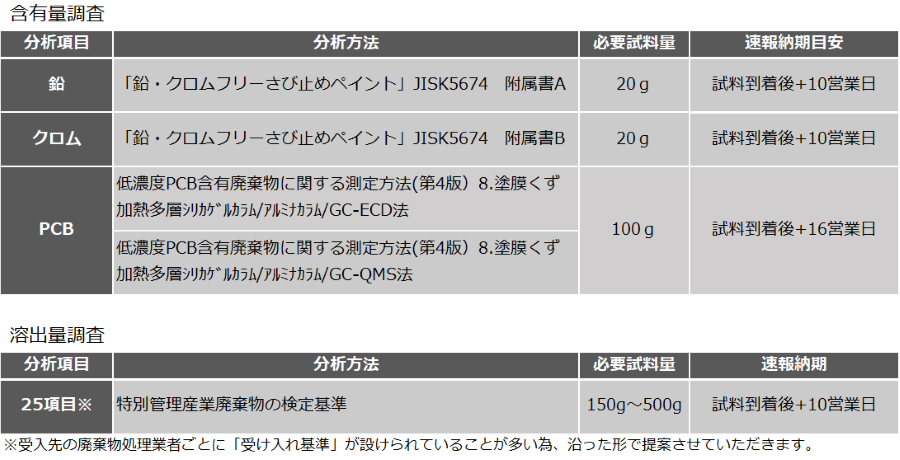
Below is an example of analytical methods and the required sample quantities.
Related Information
Proper investigation in accordance with applicable laws and regulations is essential when handling paint coatings.
● Waste Management and Public Cleansing Act (Waste Management Act)
https://www.env.go.jp/recycle/waste/laws.html
● Act on Special Measures for Promotion of Proper Treatment of PCB Waste
http://www.env.go.jp/recycle/poly/law/
● Analytical Methods for Low-Concentration PCB-Containing Waste (5th Edition)
https://www.env.go.jp/recycle/poly/manual/teinoudo_ver5.pdf
● Major Revisions from the 4th to the 5th Edition (Reference)
https://www.env.go.jp/recycle/poly/manual/teinoudo_ver5_kaisetu.pdf
● Notification on the Investigation of Paint Coatings Containing High-Concentration Polychlorinated Biphenyls (PCBs)
https://www.env.go.jp/recycle/no011220.pdf
● Notification on Criteria for Determining Low-Concentration PCB-Contaminated Waste
http://www.env.go.jp/recycle/1903283.pdf
● PCB Early Disposal Information Website – Safe Disposal Before the Deadline
http://pcb-soukishori.env.go.jp/
