
What is PM2.5?
PM2.5 refers to fine particulate matter with an aerodynamic diameter of approximately 2.5 μm or less. More precisely, it is defined as particulate matter that passes through a size-selective inlet designed to remove 50% of particles with a diameter of 2.5 μm, meaning that a small proportion of particles larger than 2.5 μm may also be included.
Fine particles with a diameter of 2.5 μm or less can penetrate deep into the lungs when inhaled and deposit in the alveoli and other regions beyond the airways. As a result, they are considered to have significant impacts not only on respiratory diseases such as asthma and bronchitis but also on the cardiovascular system.
Because PM2.5 reaches the deepest parts of the lungs, concern extends beyond its mass concentration to include the concentration of hazardous substances contained within the particles, unlike SPM*, where only mass concentration was the primary concern.
●Environmental Standard (desirable level established under Article 16, Paragraph 1 of the Basic Environment Act to protect human health)
⇒ Annual average: 15 μg/m³ or less AND Daily average: 35 μg/m³ or less
Interim advisory level: Public alerts are issued when the daily average is expected to reach or exceed 70 μg/m³.
*SPM (Suspended Particulate Matter: particulate matter that passes through a size-selective inlet designed to remove 100% of particles with a diameter of 10 μm)
-
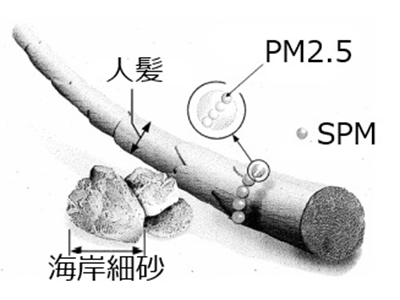
Comparison of PM particle size with human hair and beach sand (conceptual illustration) (Source: U.S. EPA)
-
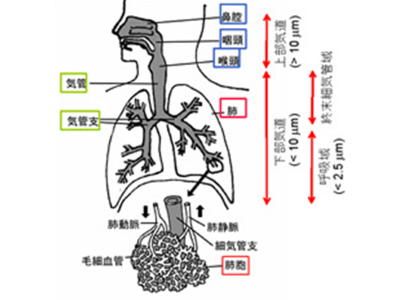
Human respiratory system and particle deposition regions (conceptual illustration) (Source: National Institute for Environmental Studies)
Sources and Current Status
Particulate matter consists of particles emitted directly from combustion and other processes, as well as secondary particles formed through atmospheric chemical reactions involving gaseous air pollutants such as sulfur oxides (SOx), nitrogen oxides (NOx), and volatile organic compounds (VOCs).
Emission sources include stationary facilities such as boilers, incinerators, coke ovens, and mineral storage sites, as well as anthropogenic sources such as automobiles, ships, and aircraft. Natural sources including soil, oceans, and volcanic activity also contribute.
Due to measures such as regulations on emission facilities under the Air Pollution Control Act and vehicle emission controls, the annual average concentrations of both SPM and PM2.5 have shown a declining trend.
Source: Ministry of the Environment, Japan
Investigation and Analysis Process (After Your Request)
- Step 1
-
Sampling
PM2.5 (and SPM) samples are collected.
〇We use a size-selective inlet designated under the U.S. EPA Federal Reference Method (FRM).
〇Quartz fiber filters or Teflon filters are selected depending on the analytical items.

- Step 2
- Analysis (Mass Concentration Measurement)
The collected samples are weighed to determine their mass concentration.
〇Because PM2.5 analysis requires weighing extremely small amounts of particulate matter, we maintain a dedicated weighing room with strictly controlled temperature and humidity.

- Step 3
- Analysis (Component Analysis)
In addition to mass concentration measurements, component analysis can also be performed.
〇Carbon Components
Measurement of organic carbon (OC) and elemental carbon (EC).
〇Ionic Components
Measurement of cations and anions to help evaluate secondary aerosol formation.
〇Metals
Trace metal analysis is conducted in a laboratory with carefully controlled air conditioning to ensure analytical accuracy.
〇Polycyclic Aromatic Hydrocarbons (PAHs)

Features
Extensive Experience in Large-Scale Surveys
Tokyo Metropolitan Government: Collection and Component Analysis of Fine Particulate Matter (FY2008–FY2012)
Integrated In-House Service from Planning to Reporting
Because we own both our field investigation equipment and analytical instruments, we can manage every stage of the project—from planning through reporting—entirely in-house.
Comprehensive Quality Control and Technical Expertise
●Our integrated in-house investigation and analysis system enables rigorous quality control.
●We conduct research on PM2.5 and even smaller nanoparticles, supported by advanced technical expertise.
Case Studies and Achievements
●Tokyo Metropolitan Government: Collection and Component Analysis of Fine Particulate Matter (FY2008–FY2012)
●Sumida City: Investigation of Hazardous Air Pollutants and Fine Particulate Matter (PM2.5)
●Toyota City: Component Analysis of Fine Particulate Matter (PM2.5)
Notes
●Our Nanoparticle Research
We conduct research on airborne fine particles (PM2.5) and particularly on nanoparticles (particles smaller than 0.1 μm), focusing on toxicity assessment and the characterization of their chemical composition using highly sensitive analytical methods. Nanoparticles are of particular concern because they not only exhibit extremely high deposition efficiency in the alveoli but can also penetrate cells and blood vessels, potentially affecting human health.
Our research has demonstrated that nanoparticles contain significantly higher levels of genotoxic substances (agents capable of causing genetic mutations) and carcinogens such as nitroarenes than larger fine particles. We were also among the first in the world to report that nanoparticles function as carriers of genotoxic and carcinogenic substances within the human body1,2).
1) Kawanaka et al., Atmospheric Environment (2004), 38, 2125-2132
2) Kawanaka et al., Journal of Health Science (2006), 52, 352-357
