
Current Status of Organofluorine Compounds
Artificial organofluorine compounds such as PFOS (Perfluorooctane Sulfonic Acid) and PFOA (Perfluorooctanoic Acid) have long been used as additives in a wide range of products, including water repellents, stain-resistant agents, and surfactants. In recent years, their persistence in the environment and bioaccumulation on a global scale have become evident, leading to increasing international regulations.
PFOS was listed under the Stockholm Convention on Persistent Organic Pollutants (POPs Convention) in 2010, followed by PFOA in 2019. PFHxS, which has been used as an alternative to PFOS, was also added to the convention in 2022. Compounds covered by the POPs Convention are regulated in Japan as Class I Specified Chemical Substances.
Current Regulations on PFOS and PFOA
Environmental Water
Since May 2020, PFOS and PFOA have been designated as monitoring items for public water bodies and groundwater. The provisional guideline value is 0.00005 mg/L for the combined concentration of PFOS and PFOA.
Drinking Water
PFOS and PFOA have been detected in both raw and treated drinking water. To ensure appropriate water quality management, they were reclassified from "Items for Further Study" to "Water Quality Management Target Items" on April 1, 2020. The provisional target value is 0.00005 mg/L (50 ng/L) for the combined concentration of PFOS and PFOA.
-
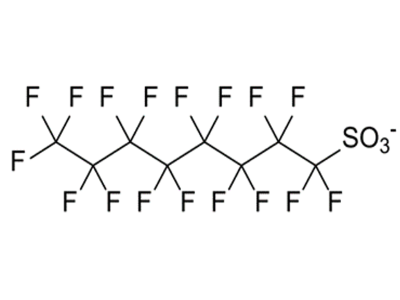
PFOS (Perfluorooctane Sulfonic Acid)
-
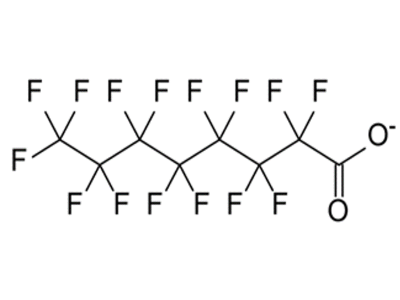
PFOA (Perfluorooctanoic Acid)
Applications
● Evaluate treatment efficiency by analyzing water before and after treatment prior to environmental discharge.
● Verify that wastewater is properly treated before being released into the environment.
● Conduct monitoring surveys to understand changes in PFOS and PFOA concentrations in rivers and lakes.
● Analyze the content of PFAS compounds in commercial products and materials.
Survey and Analysis Process
- Step 1
- Sample Collection
Our field technicians can visit your site to collect samples. We also accept customer-provided samples. Please contact us for details.
- Step 2
- Pretreatment and Analysis
Appropriate pretreatment is performed according to the sample matrix, followed by analysis using liquid chromatography-tandem mass spectrometry (LC-MS/MS).
Analysis and Reporting Process
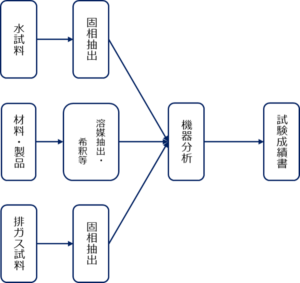
Please contact us for detailed sample volume requirements for each sample type.
- Step 3
- Issuance of Test Report
We will provide an official analytical test report upon completion.
Our Organofluorine Compound Analysis Services
We provide analyses in accordance with the analytical methods specified in the Ministry of the Environment notification, "Implementation of Environmental Quality Standards for the Protection of Human Health Relating to Water Pollution" (May 28, 2020).
Organofluorine compounds such as PFOS are commonly found in everyday products, including Teflon-coated materials and water-repellent products, making contamination during analysis a significant concern.
With many years of experience analyzing organofluorine compounds in environmental water, wastewater, and various other sample types, we carefully manage laboratory equipment and analytical procedures to ensure strict quality control and highly reliable analytical results.
Experience and Achievements
We were commissioned by the Ministry of the Environment to conduct the "FY2019 Study on Organofluorine Compounds," which included nationwide monitoring of PFOS and PFOA in aquatic environments, as well as administrative support for expert committee meetings concerning environmental target values.
