
Overview
A Living Environment Impact Assessment is an environmental assessment required under the Waste Management and Public Cleansing Act for obtaining permits or filing notifications related to waste treatment facilities. Through this assessment, facility plans are developed with due consideration for the living environment, including verification of compliance with applicable environmental standards during the planning stage.
In response to growing public concern over environmental issues, increasing anxiety regarding emerging environmental risks such as dioxins, declining public trust in waste treatment operators, and a rise in disputes related to the construction and operation of waste treatment facilities, the Waste Management and Public Cleansing Act was amended in June 1997, making Living Environment Impact Assessments mandatory.

[ Read More ]
Applications
When constructing a waste treatment facility
When applying for a permit to construct a waste treatment facility, applicants must submit a report summarizing the results of the Living Environment Impact Assessment. For municipal solid waste treatment facilities established by municipalities or other public entities, the assessment must be completed before the required notification is submitted.
Since the timing of the assessment and administrative procedures varies depending on the type of facility, careful planning from the initial project stage is essential.
Survey & Analysis Process (After Your Request)
- Step 1
- Survey Planning
Based on discussions with the client, we organize the project plan, conduct site reconnaissance to understand the surrounding environment, and prepare a Living Environment Impact Assessment plan. The proposed survey plan is then coordinated with the relevant permitting authority. In some municipalities, submission of a survey plan is mandatory as part of the preliminary consultation process.
- Step 2
- Conducting the Living Environment Impact Assessment
We conduct baseline environmental surveys, impact prediction, impact analysis, and evaluate appropriate environmental protection measures.
Baseline conditions are primarily assessed using existing data, supplemented by field surveys where necessary. Assessment items selected in Step 1 may include air quality, noise, vibration, odor, water quality, and groundwater.
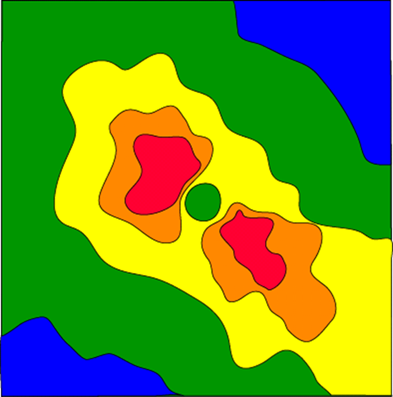
Impact predictions are carried out using simulation models and other analytical methods to evaluate the effects of facility operation.
Impact analysis focuses on two key aspects: whether impacts on the living environment can be reasonably avoided or minimized, and whether environmental quality objectives and applicable environmental standards are satisfied.
Where necessary, we recommend additional environmental protection measures based on the assessment results.
The results are compiled into a Living Environment Impact Assessment Report, which is then reviewed and coordinated with the relevant permitting authority.
- Step 3
- Regulatory Procedure Support
Under the Waste Management and Public Cleansing Act, incineration facilities and final disposal sites require public comment procedures after submission of the installation permit application, while municipal waste treatment facilities require similar procedures after completion of the Living Environment Impact Assessment. These procedures include collecting opinions from local residents and reviews by expert committees.
We provide comprehensive support for responding to public comments, organizing public information meetings, and assisting facility operators during expert review processes.
.jpg)
Features
Extensive Experience
Drawing on our extensive experience in environmental impact assessment projects, we provide reliable consulting services for Living Environment Impact Assessments. Although many of our projects are located in the Kanto region, we also leverage professional environmental networks such as the EM Network to deliver assessment services nationwide, from Hokkaido to Kyushu.
Comprehensive Project Support
From survey planning and field investigations to report preparation, we provide integrated project management to ensure efficient execution and successful project implementation.
Comprehensive Permit and Approval Support
We also assist with procedures under related legislation, including Article 15 (Application for Installation Permit) of the Waste Management and Public Cleansing Act and Article 51 (Exemption from Location Restrictions) of the Building Standards Act, through referrals to qualified administrative scriveners.
